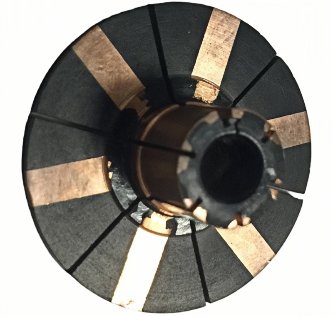
1. Understanding the Components
A. Coreless Motor
- What it is: A type of electric motor where the rotor windings are wound directly around a lightweight, non-magnetic core (often plastic or laminated metal) rather than being wound around a solid iron core.
- Advantage: By eliminating the heavy iron core, the motor becomes extremely lightweight, very efficient, and generates very little cogging torque (the slight “sticking” feeling when you try to start a motor slowly).
- Commonly Used In: Drones, small robotics, electric toothbrushes, medical devices, and compact appliances where weight and efficiency are paramount.
B. The Commutator (General Function)
- What it is: A physical segmented ring (made of copper segments) used in brushed DC motors.
- What it does: Its job is to periodically reverse the current going through the armature windings. This continuous reversal of current is what creates the alternating magnetic field, generating continuous torque to keep the motor spinning.
- The Drawback: The physical rubbing action of the brushes against the commutator creates friction, electrical sparking (arcing), and mechanical wear, leading to decreased efficiency and reduced lifespan.
💡 2. The Conceptual Conflict & The Solution
The conflict is: Coreless motors are inherently designed for high efficiency and low wear, making the friction and wear associated with a traditional physical commutator unacceptable.
Therefore, the “commutator” function in a modern coreless motor is replaced by an electronic system.
✅ The Replacement: Electronic Commutation (BLDC Operation)
Instead of physical contacts, coreless motors are almost always designed as Brushless DC (BLDC) motors.
- How it works: An external electronic device, usually called a Motor Controller or Electronic Speed Controller (ESC), analyzes the motor’s position.
- Sensing: It uses Hall-effect sensors (or back-EMF sensing) to detect the exact position of the rotor windings.
- Switching: The ESC then precisely sends electrical power to the correct windings in the correct sequence to maintain continuous torque, without any physical brushes or commutator segments touching.
Conclusion: When you hear “coreless motor commutator,” the context almost certainly implies the electronic switching process that replaces the physical commutator found in older motor designs.Coreless Motor Commutators