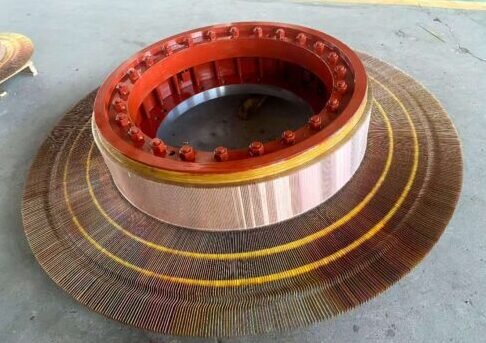
1. What is a V-Ring Commutator?
A commutator is essentially a specialized electrical switch that allows current to be transferred from a stationary source (like a power supply) to a rotating shaft (like a motor shaft).
- The V-Shape: The defining feature is the “V” shape, which is not arbitrary. This specific geometry is engineered to provide superior mechanical support, excellent sealing capabilities, and robust electrical contact compared to simpler slip rings or traditional commutators.
- Function: It maintains electrical continuity and mechanical integrity when the rotating shaft is subjected to high torque, extreme angles, vibration, dust, or contaminated environments.V-Ring Commutator, Assembled commutators
⚡ 2. Why Use a V-Ring vs. Standard Components? (The Advantage)
The primary reason engineers select a V-Ring commutator over simpler slip rings or basic brushes is its robustness and high-performance rating.
| Feature | V-Ring Commutator Advantage | Significance in Application |
|---|---|---|
| Mechanical Stability | The V-shape locks components in place, resisting misalignment and sheer forces. | Prevents premature wear and catastrophic failure in vibrating machinery. |
| Sealing Capability | It can be designed with excellent sealing elements. | Essential for dusty, dirty, wet, or high-particle environments (e.g., mining, construction). |
| Current Handling | Designed to manage higher amperage and continuous high-torque loads. | Necessary for large industrial motors that draw significant power. |
| Durability | Superior resistance to arcing, contamination, and thermal cycling. | Ensures long operational lifespan in 24/7 industrial use. |
🛠️ 3. Primary Applications (Where are they used?)
V-Ring commutators are not for small household appliances; they are built for industry. You will find them in machinery that meets one or more of the following criteria: High Power $\rightarrow$ High Torque $\rightarrow$ Harsh Environment.
- Heavy Industrial Motors: Large AC/DC motors used in manufacturing plants, chemical processing, or metallurgy.
- Material Handling Equipment: Conveyor belts, large industrial pumps, mixers, and lift mechanisms where continuous, high-force operation is required.
- Mining and Construction Machinery: In equipment used in underground or outdoor construction sites where dust, water, and physical shock are constant threats.
- Robotics and Automation: In specialized industrial robotic joints or actuators that require precise, reliable power transfer under extreme operating conditions.
- Machine Tools: Large machine tools (like milling or cutting equipment) where the motor must maintain flawless operation despite high vibration and potential coolant exposure.
📝 Summary Checklist for Implementation
If you are selecting or specifying this component, remember that the V-Ring is chosen when the application demands:
- High Amperage / High Power.
- Constant Motion (Rotation).
- Resistance to Contaminants (Dust, Water, Metal Shavings).
- Tolerance to Physical Stress (Vibration, Shock).