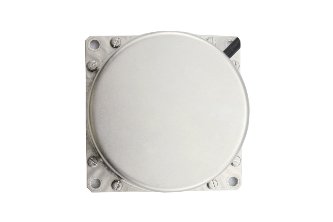
The operating principle of the fiber optic gyroscope (FOG) is based on the Sagnac effect. The Sagnac effect is a general correlation effect of light propagating in a closed optical path rotating relative to inertial space. Specifically, two beams of light with identical characteristics emitted from the same light source travel in opposite directions along the same closed optical path and finally converge at the same detection point.
When there is an angular velocity rotating around the axis perpendicular to the plane of the closed optical path relative to inertial space, the optical paths traveled by the two beams in opposite directions differ, generating an optical path difference proportional to the rotational angular velocity. Therefore, the rotational angular velocity can be calculated by acquiring the optical path difference and corresponding phase difference data.
Compared with mechanical gyroscopes and laser gyroscopes, fiber optic gyroscopes have the following advantages:
Fewer components, robust and stable structure, with strong resistance to shock and acceleration.
Longer coiled optical fiber delivers detection sensitivity and resolution improved by several orders of magnitude over laser gyroscopes.
No mechanical transmission parts or mechanical wear, ensuring a long service life.
Easy integration with integrated optical circuit technology for stable signals, supporting direct digital output and computer interface connection.
Adjustable precision and wide dynamic range by changing fiber length or light cycle times in the coil.
Short propagation time of coherent light beams, enabling instantaneous startup with no preheating required in principle.
Compatible with ring laser gyroscopes to form sensors for various inertial navigation systems, especially strapdown inertial navigation systems.
Simple structure, low cost, compact size and light weight.
Classification
By Working Principle
The Interferometric Fiber Optic Gyroscope (I-FOG), the first-generation FOG, is the most widely adopted type. It adopts multi-turn fiber coils to enhance the Sagnac effect. A dual-beam ring interferometer composed of multi-turn single-mode fiber coils achieves higher precision but results in a more complex overall structure.
The Resonant Fiber Optic Gyroscope (R-FOG) represents the second generation of FOGs. It utilizes a ring resonator to amplify the Sagnac effect and realize cyclic propagation for higher precision, enabling the use of shorter optical fibers. R-FOG requires high-coherence light sources to strengthen resonance in the resonant cavity, yet such light sources also induce numerous parasitic effects. Eliminating these parasitic effects remains a major technical challenge.
The Stimulated Brillouin Scattering Fiber Optic Gyroscope (B-FOG), the third-generation FOG, is an upgraded solution of the former two types and is currently still in the theoretical research stage.
By Optical System Composition
Integrated optical FOG and all-fiber FOG.
By Structure
Single-axis fiber optic gyroscope and multi-axis fiber optic gyroscope.
By Loop Type
Open-loop fiber optic gyroscope and closed-loop fiber optic gyroscope.
Since its debut in 1976, the fiber optic gyroscope industry has achieved rapid development. Nevertheless, a series of technical defects still restrict its precision, stability and large-scale application, mainly including:
Influence of transient temperature changes. Theoretically, the two counter-propagating optical paths in the ring interferometer are strictly equal only under time-invariant system conditions. Experiments prove that phase error and drift in rotational speed measurement are proportional to the time derivative of temperature, which causes severe interference, especially during the preheating phase.
Influence of vibration. Vibration severely distorts measurement results. Reasonable packaging is required to ensure coil rigidity, and optimized internal mechanical design is essential to avoid resonance.
Influence of polarization. The widely used single-mode optical fibers are dual-polarization mode fibers. Fiber birefringence causes parasitic phase differences, necessitating polarization filtering. Depolarized fibers can suppress polarization interference but will increase overall costs.
To optimize the comprehensive performance of FOGs, multiple optimization solutions have been proposed, including structural upgrades for core components and optimized signal processing algorithms.